
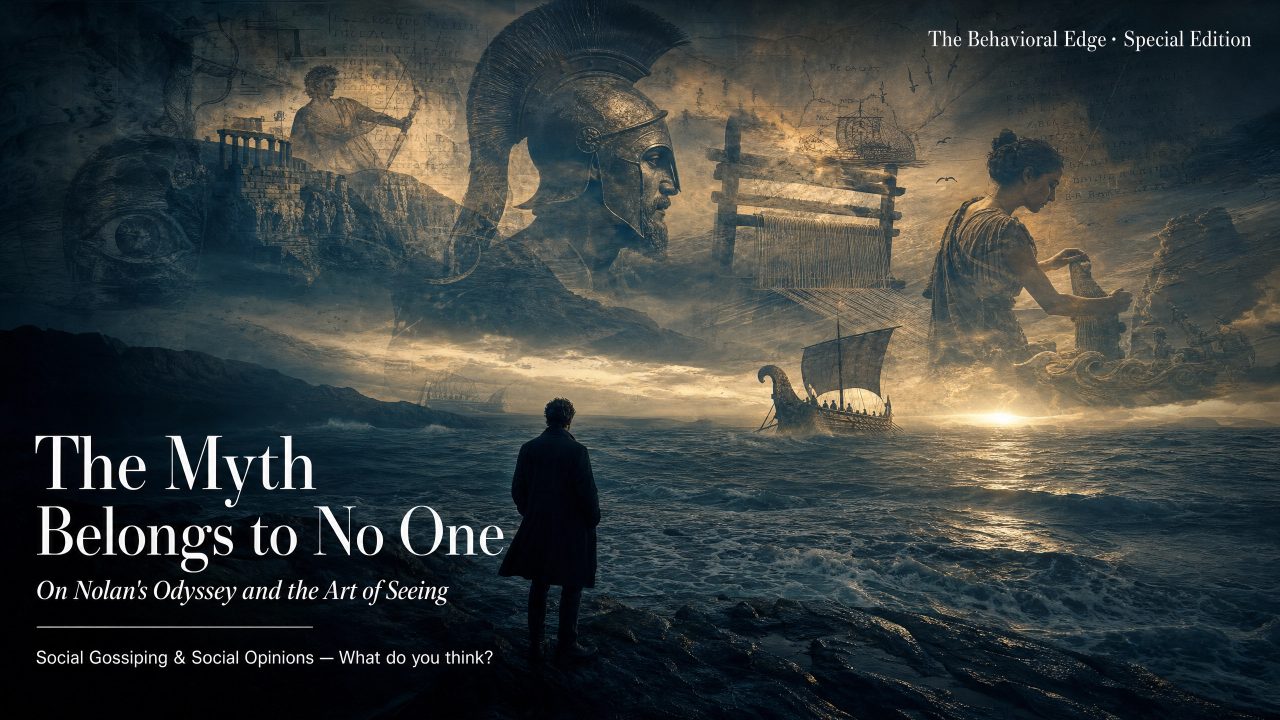
From my POINT of VIEW (YOU)…and based on a discussion about perception with Christina Sakka
Since Christopher Nolan’s The Odyssey arrived in cinemas, a familiar chorus has risen: he didn’t follow the text. Scholars measure the film against Homer line by line. Purists complain that Odysseus has lost his trickster’s tongue, that Circe has been rewritten, that even the helmet on Matt Damon’s head belongs to the wrong century.
I want to offer these judges a different lens — a systemic one. Because before we ask whether the artist was faithful to the myth, we should ask a more honest question: faithful to which myth, exactly?
The Original That Never Existed
Here is the paradox the fidelity critics forget: there is no original Odyssey. What we call “Homer” is itself a settlement — the crystallization of centuries of oral tradition, sung differently by every rhapsode in every hall, adjusted for every audience, every island, every political moment. The bards did not recite a fixed script. They re-composed the story live, each performance a new point of view on a shared mythic structure.
The Odyssey we defend so fiercely is one version that happened to be written down. The myth was never a document. It was — and remains — a living system: a pattern of meaning that survives precisely because each generation retells it through its own eyes, its own wounds, its own questions.
So when we demand that a filmmaker “follow the script,” we are demanding fidelity to something that was never fixed in the first place. We are defending the photograph of a river and calling the river itself a distortion.
Cinema: The Seventh Art, Not the Seventh Copy
Cinema was named the seventh art for a reason.
An art form does not transcribe — it transforms. The painter does not reproduce the landscape; she reveals what the landscape awakened in her. The composer does not record the storm; he gives us the storm as it moved through him.
A film adaptation, then, is not a translation exercise to be graded for accuracy. It is a his-story — one artist’s history, one perspective made visible, one point of view given form, light, rhythm, and flesh. Nolan’s Odysseus is not Homer’s Odysseus, and he was never meant to be. He is Nolan’s answer to the question every artist must ask of a myth: what does this story mean when I look at it — here, now, through everything I am?
When Nolan strips away the hero’s impish cunning and gives us instead a man haunted by what survival cost him, he is not failing Homer. He is doing what the myth has always invited: entering the pattern and letting it reorganize around a new center of gravity. His Circe — a woman whose magic does not transform men but reveals them — is not a betrayal of the text. It is a twenty-first-century consciousness meeting a Bronze Age story and discovering something the original audience could not yet see.
The Systemic Question: How Does the Point of View Settle?
As a systemic thinker, I propose we change the evaluation criterion entirely.
The wrong question is: Did he follow the script? The right question is: Does the point of view settle into a coherent outcome?
Every artistic choice is an intervention in a system. Change Odysseus’s character, and the whole narrative field reorganizes — Penelope means something different, the suitors mean something different, homecoming itself means something different. The measure of the work is not whether each element matches the source, but whether the new configuration holds: whether it achieves internal coherence, emotional truth, and a perspective that could not have existed before this artist made these choices.
Judge the film as an ecosystem, not as a checklist. Ask whether it breathes. Ask whether its vision of the myth — this vision, not the one you carried into the theater — completes itself on its own terms. That is how we judge art. Fidelity is how we judge photocopies.
The Deeper Invitation
There is something almost Homeric in the irony of this debate. Odysseus himself was polytropos — the man of many turns, many versions, many masks. He told his story differently to every listener: one tale for the Phaeacians, another for the swineherd, another for his own wife. The hero of the Odyssey is, quite literally, an unreliable narrator of his own myth.
A story whose hero constantly reinvents his own telling cannot honestly demand a single authorized version of itself.
So my invitation to every judge of this film is simple: open your view and enjoy the art. Release the comparison for two hours. Let the artist’s point of view work on you the way the rhapsode’s voice once worked on listeners who had heard the story a hundred times before — and who came back not for the plot, which they knew, but for the telling, which was always new.
The experience is not in the fidelity. The experience is in the encounter — between an ancient pattern and a living perspective, between the myth and the person you are while watching it. That encounter is the seventh art’s entire gift.
Homer would recognize it immediately. He did it first.
Nikolas Fragkias
